
In every generation a person is obligated to see themselves as if they left Egypt

Before the original Passover offering, the one recorded in Torah, the one that happened before anyone left Egypt, before the last plague, before the rush to leave, before the ritual signifying that the Israelites will have left, before all of that, there was an act of massive civil disobedience. The Israelites were commanded to take an unblemished yearling lamb on the tenth of the first month, which they were to “keep” until the fourteenth when the lamb was to be offered and then eaten—its blood having been splattered on the doorposts of the houses—with matzah and bitter herbs. The lamb, according to the midrash, was a god of the Egyptians. It was chosen to signify that the Israelites were no longer subservient to the Egyptian divine hierarchy at whose head stood the Pharoah. This taking of the yearling and keeping it for four days was a demonstration that the Israelites were claiming their own dignity, their freedom to choose their own worship and their own God. This was a part of the unlearning of enslavement. 

The logic of slavery is a logic of supremacy and subservience. It is grounded in a belief on the part of the enslaver that the enslaved person by right was not as fully human, as fully a person as the enslaver. It only works when there is also an acquiescence or even tacit belief on the part of the enslaved that this is right. It is this belief and the acquiescence in this belief that allows all supremacy and oppression to happen. (This is not unique to any one instance. Aristotle argued that slaves have a “different soul” than free persons.) This is, of course, a lie. A lie that was the point of the demonstration of the liberation of the Israelites. From Moses leaving the Pharaoh’s house and identifying with his Israelite siblings and not his royal upbringing, to the final destruction of the Egyptian kingdom, the point of the liberation from Egypt was that oppression will not stand because all oppression is based on falsehood and God is the God of truth and righteousness. 

When reading the statement at the heart of the Haggadah “In every generation a person is obligated to see themselves as if they left Egypt,” we must be wary of two different mistaken readings. The first mistake is glossing over the Hebrew word for “person” which is adam meaning any person, not necessarily a Jewish person. In every generation every person is obligated to see themselves is if they left Egypt. Liberation is not a gift that was bestowed exclusively upon the Jews. It is a gift bestowed upon humanity. Every person is obligated, following the exodus story to see through all types of supremacy and liberation as based on a lie. 

The second mistake is that people understand that the obligation is to remember that we were slaves; that the point is that since we were enslaved we can empathize with others who were enslaved and that we experienced the pain and suffering as other contemporary and near contemporary enslaved peoples. In fact, the obligation is to see ourselves as having left Egypt, that is as having been liberated. It is not the enslavement that is the important part of our story, but the fact and possibility of liberation. If the Israelites could be liberated, so could all other peoples be liberated from oppression, from supremacy, from enslavement.

Writing this, this year, in this moment when the order of the day is so far from liberation, when in fact my country and my kin are wreaking havoc and death at home and abroad; when screaming and protesting in the streets seems close to helpless; it may be more important than ever to remember that in order to get to liberation we have to liberate ourselves, from the myths of supremacy that still cloud our moral thinking: Jewish supremacy, white supremacy, American exceptionalism. We must leave that bondage.

There is a midrash that says that in the Red Sea every single person was able to just point and say “That is my God, and I will praise God.” May we all glimpse a moment of that clarity.
Goldberg vs. Tlaib—WUT?

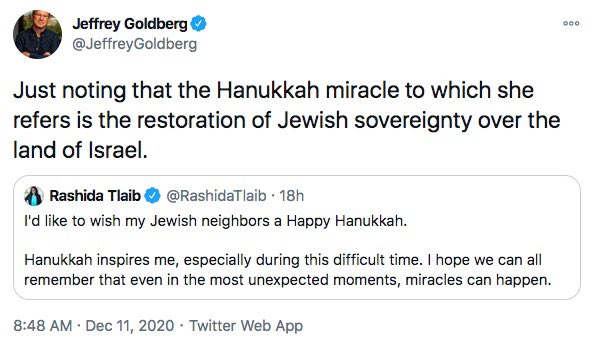
On December 10 Representative Rashida Tlaib, Congresswoman from the Michigan 10th District tweeted: “I’d like to wish my Jewish neighbors a Happy Hanukkah. Hanukkah inspires me, especially during this difficult time. I hope we can all remember that even in the most unexpected moments, miracles can happen.” The Tweet seems innocuous, no different than probably hundreds of such messages which politicians send to their constituents, or to the broader public, wishing all a happy holiday. Representative Tlaib also included some sweet pablum about miracles, saying she herself draws inspiration from the holiday in this difficult time. 

Justin Amash, the Libertarian Congressman from Michigan’s 3rd District tweeted: “Wishing a blessed and happy Hanukkah to all who celebrate!” Representative Dan Kildee of Michigan’s Fifth District tweeted: “Happy #Hanukkah to everyone in mid-Michigan and around the country celebrating the first night of the Festival of Lights! Even though this holiday looks different this year, I hope happiness, love and hope fill your homes for the next eight day and many more to come.” Congressman Kildee added a Hanukkah emoji and a photograph which showed a menorah with eight candles and a present. While Flint has a few synagogues and a long Jewish presence, there are not that many Jews in the area represented by Kildee. His greeting, like those of the other politicians were not so much de riguer as the signs of civility. Before a religious holiday it is befitting for a political leader to wish those who celebrate that holiday a happy holiday. If they want to go the extra step, like Kildee, and show some understanding of the holiday (“first night” “eight days”)—great. If they want to draw some inspiration from the meaning of the holiday, even better. However, even the boilerplate greeting that Justin Amash sent is a welcome sign of civility in our civic culture. 

It was somewhat striking then that Jeffrey Goldberg, the editor of the Atlantic, who happens to be Jewish, decided to “dunk” on Tlaib. First thing the next morning, Goldberg retweeted Tlaib’s tweet with the comment: “Just noting that the Hanukkah miracle to which she refers is the restoration of Jewish sovereignty over the land of Israel.” The “just noting” introduction is the Twitter giveaway that the following comment is significant and cutting. It seems that Goldberg thought that Tlaib was aligning herself with Ancient Jews whom she would not align herself with had they lived today. In other words, Goldberg seems to be implying that Tlaib is mistakenly or hypocritically celebrating Jewish restoration of sovereignty over the land of Israel, while at the same time she is a supporter of Palestinian rights. 

So, first, Goldberg’s comment replaces the discourse of civility—politician wishes their constituents well—with the more common Twitter idiom of political snark and sarcasm. The Tweet also, perhaps inadvertently, placed itself in the middle of the Hanukkah controversy itself. Many Jewish Twitterati immediately replied to Goldberg that he was getting the holiday wrong, and that the miracle of Hanukkah was actually the cruz of oil which burned for eight days. Goldberg is a learned Jew and therefore he would have known this. In fact he probably knows that there are two different miracle stories which are in tension and perhaps in conflict with each other. 

There are two prayers that are unique to Hanukkah. One is said in Jewish rites, in the amidah prayer which is recited thrice daily. The second is a liturgical poem, recited in Jewish communities of European origin during the candle lighting ritual. In the first prayer, also known as al hanisim/about the miracles, the miracle that is extolled is the victory of the few over the many, the righteous over the wicked. In the liturgical poem (maoz tzur translated unfortunately as “Rock of Ages”) the miracle is that when there were not enough cruses of sanctified oil, the sanctified oil that was left lasted for eight days. 

Goldberg’s choice of the military victory is not a neutral choice. The rabbis of the Talmud, the 6th century Babylonian Jewish text which expounds on Hannukah in all its legal complexity for the first time, chose the miracle of the oil and glossed over the military victory. The rabbis were not very fond of the Hasmonean house which descended from the Maccabees, so this may not be surprising. They also preserved an acute memory of the death and destruction which accompanied the destruction of the Second Temple in 70 CE and the Bar Kochba revolt in 135 CE. The rabbis of the Talmud have a strong preference for pacifism. 

However, pacifism did not serve the nascent Zionist movement well, and so when searching for militant ancestors they could find none better than the Maccabean band of zealots. The Zionist movement resurrected the fight for national sovereignty from the dust of the extracanonical books of the Maccabees. 

This Twitter scrap played out as it did because of the two registers in which everything religious plays out in today’s political realm. Christian, Muslim, Jewish, have all become fighting words. Any Tweet that a Muslim-American politician tweeted on a Jewish topic would be scrutinized for its political content. It would not and did not matter that the message was a human message not on the field of battle. Goldberg is picking up a cudgel from another fight that is obviously not yet over for him.

The call for civility is usually a call for the weak to disarm and not to use the weapons of the strong. However, there is great benefit when around the margins there is a recognition that the battleground has boundaries. There is no glory when the Jewish editor in chief of one of the magazines which sets the intellectual agenda for the public space dunks on a Muslimah Congresswoman of color on an issue which was obviously not on the field of battle. 

_______________

Dr. Annette Yoshiko Reed has a phenomenal Twitter thread with links if you want to really geek out on the history of Hanukkah.

Daf Shvu’i: Give me 40 minutes or so and I’ll give you a daf or so

This week we get into the longest extended discussion of poverty relief in the Babylonian Talmud. Along with the serious business of assessing, collecting, and distributing taxes for infrastructure and poverty relief, there is the serious business of meeting Elijah the Prophet, and watching Rabbi Judah the Prince deal with famine. Also, should Sages pay taxes?

https://soundcloud.com/irmiklat/daf-shvui-baba-bathra-7b-8b

As always, deepest gratitude to Eli Ungar-Sargon for sound editing.

Achieving our Country (California Nation)

The days since the election have brought with them a torrent of self-criticism from the left, from the not so left, and from the never-was-left wings of the Democratic Party. Everybody accusing everybody else of the loss. The white working class was not given its due. There was too much attention paid to identity politics. Not enough attention was given to foreign policy concerns, or any concerns other than Trump’s vulgarity and panoply of hatreds. And on and on. In my humble opinion all of that is perhaps necessary venting but, ultimately, just so much noise.

The election posed a choice between two visions of what America is and/or could be. On the one hand was the claim that the more perfect union, which is presented as the very reason for the Constitution, is achieved by increasing and expanding the community of those who would receive the Blessings of Liberty, and be of those that the promotion of the general Welfare would impact. On this claim Justice is open to be claimed by all who reside in this country; domestic tranquility is a right of all; and the people who are being commonly defended are of every race, religion, ethnicity, sexual orientation, immigration status, and ability. On this side of the argument, in broad terms, achieving our country means welcoming the stranger, caring for the resident, understanding that “citizens” are individuals who treat one another as bearers of the relevant kind of responsibility (as Jeffrey Stout has argued), and not only those who bear the relevant documents. Continue reading

Wake up! (On T’shuvah/Repentance & Criminal Justice Reform)

What does it mean to wake up? Maimonides, in his Laws of Repentance (Chapter 3) writes that the function of the shofar is to wake a person up. “Those who forget the truth in the emptiness of the passing time…” should heed the blast of the ram’s horn and stir from their slumber. Nowadays, it is common in activist quarters to speak of people who have recognized certain systemic injustices as being “woke.” Maimonides and the activists are speaking to the same point. There is a crying need to step out of the familiar and often lazy thinking about our own and society’s actions. We are called to take an unvarnished look at our society, and ourselves. Continue reading

A Kavanah [Intention] for the Seventh Night of Hanukah

Tonight we light the seventh Hanukah light.חנוכיה

The Hanukah lights are about the boundary—between inside and outside, between public and private, between the market and the home. Also between the past and the present, and between ourselves and others.

The Torah portion that we read today in synagogue recounts the Joseph story. It is called miketz, at the end. The portion begins at the end of Joseph’s seven years of imprisonment on the false charge of attempting to rape his master’s wife. Joseph is called to Pharaoh from his cell to interpret Pharaoh’s dream, which he does successfully. He is rewarded with the highest position in the kingdom—second only to Pharaoh himself. Joseph is given authority over all the lands and resources of the kingdom, authority to collect food and prepare Egypt for the famine to come. Continue reading

A Kavanah [intention] for the Second Night of Hanukah

Tonight we light the second Hanukah light.

The original Hanukah story is told primarily in the first Book of Maccabees (Sefer HaMakabim), which was written in near proximity to the second century BCE events which are recounted therein. Some scholars think that the original author was a witness to the events. I Maccabees, the book, tells the story of the victorious military revolt of a band of faithful Judean priests over the forces of the Hellenizers (called “sons of Belial”) and the army of the empire. The climactic scene is the capturing, purification, and renewal of the Temple in Jerusalem. The eight day holiday of rededication (from whence the name Hanukah/dedication comes) was originally a thanksgiving celebration for the miraculous military victory of the Hasmoneans over their internal and external enemies.

Hanukah, one of the two post-biblical holidays in the Jewish calendar, was recorded in the Scroll of Days on Which it is Forbidden to Fast. When incorporated in the Talmudic discussion (Babylonian Talmud Shabbat 21b), the explanation for the holiday is radically changed.

For when the Greeks entered the Sanctuary, they defiled all the oil in the Temple, and there was not enough oil to light [the candelabrum]. When the Hasmoneans defeated the Greeks, they searched but found only one cruze of oil sealed with the seal of the High Priest which had not been defiled. There was only enough oil to light for one night. Miraculously, though, it burned for eight days.

From the point of view of the Hasmoneans, the rabbis seemed to have buried the lede! The military victory of the few over the many is overlooked in favor of the miracle of the oil. This was no simple oversight. The rabbis time and again, choose the path of nonviolent spiritual struggle over the bloody path of military victory. (The miraculous appearance of fire, is also a well-known sign of the presence of God.)

The rabbinic tradition is not necessarily a pacifist tradition—the Bible itself is filled with war and violent mayhem—however, the rabbis in their ultimate homeland, the house of study, labored to create a world of spiritual struggle rather than military clashes. Rabbinic heroes, such as Rabbi Akiva, engaged in nonviolent resistance to the decrees of the Roman empire—and paid the ultimate price for it. As we light the candles tonight we embrace the legacy of spiritual struggle, the nonviolent path of righteousness and justice. “This is the word of the Lord to Zerubbabel: Not by might, nor by power, but by My spirit—said the Lord of Hosts.” (Zechariah 4:6)

Sit down to stand up

One of the earliest recorded labor actions occurred in Biblical Egypt. Moses demanded that Pharaoh let the Israelites slaves go into the desert to worship their God. Moses, in other words, demanded that Pharaoh treat the Israelites as people with spiritual and physical needs, rather than as construction machines, useful for the raising of royal cities and monuments.

Pharaoh, as many a tyrant after him, refused to see the Israelites as full people worthy of respect and dignity. The only thing he could see was that they were “shirkers” who didn’t want to do a good day’s work. Pharaoh never dreamed that a rag tag people with a leader who stuttered and claimed to be speaking for an invisible God would ever be a threat to his rule and his country.

We all know how that turned out. Continue reading

Mitzvah Day 2.0 (on Walmart)

In many Jewish communities in the United States, Mitzvah Day is celebrated annually. Mitzvah (literally: commandment, colloquially: a good deed) Day is a day on which Jewish communities come together to perform all manner of community service. Atlanta’s mitzvah day announces that it contributed 570 hours of service by 190 volunteers at 10 project sites. At Temple Emmanuel in New York City people made totes for women undergoing chemotherapy, sandwiches and 300 meal bags to combat hunger, and baked fresh cookies which were packaged with organic milk boxes for children at the local day-care and after-school programs. In Los Angeles, (which seems to have been the originator of the concept) Mitzvah Day outgrew the Jewish community and was adopted by the whole city as Big Sunday.Nov 13 2014 Save the Date Flyer

All the Mitzvah Day projects seem to be well-intended and worthwhile (at least the ones I’ve seen). However, I want to suggest that the vision of Mitzvah Day is too narrow. There are some commandments which are not included in any Mitzvah Day or Big Sunday I’ve seen. These are the commandments to protest against injustice, and to treat workers fairly. Therefore, I would like to think that this Thursday, (November 13) in front of the Walmart in Pico-Rivera, will be Mitzvah Day 2.0. Workers, clergy, and community members will be protesting against Walmart’s mistreatment of its workers and demand that Walmart pay its employees at least $15 an hour, and that they have access to full time employment. Continue reading

Statement on a Week of Police Violence in Los Angeles, CA and Ferguson, MO

CLUE-LA and the Black Jewish Justice Alliance released the following statement last week about the oficer involved shooting deaths in Ferguson, MO and in Los Angeles. (I’m on the board of CLUE-LA and am a member of the BJJA and had a hand in crafting this statement.)

“The faithful city

That was filled with justice,

Where righteousness dwelt—

But now murderers.”   –Isaiah 1:21

The Black Jewish Justice Alliance, an effort by Clergy and Laity United for Economic Justice (CLUE-LA) to build a collaborative voice for justice with both African American and Jewish leaders, is extremely concerned about the recent tragic killing of a young unarmed black man, Ezell Ford, in Los Angeles. This shooting happened while the country was still grappling with the shooting of Michael Brown, another unarmed young black man by a police officer in Ferguson, MO.  While all the details of the incident are not yet certain, the shooting of Ford is the latest of many “officer involved shootings” in our city and within our country in which the victim was an unarmed black man.

America suffers from an epidemic of gun violence—some 30,000 people are killed in gun-related incidents every year. Young African-American men are disproportionally represented among intentional shooting victims.[*]  When the shooter is a police officer, who is expected to be the symbol of safety and security in the city and to be trained to limit the use of force—our mourning and concern are deepened and demand justice.

Those whom society gives license to wield violence must be held to the highest standards and the closest scrutiny. Violence must be deployed only as the absolutely last measure after all other avenues have been exhausted. When these guidelines are abrogated, swift punishment must be meted out so that the community does not labor long under the impression that there are “differing weights” and “differing measures,” nor be given to think that African American lives are worth less than others.

We demand that a full and transparent investigation of this incident be carried out and that the LAPD clearly articulate the steps that it is taking to prevent this type of incident from recurring. The Black/Jewish Justice Alliance is ready and willing to engage the LAPD in dialogue to further the recent trend toward more community policing and less violence. We would embrace being a constructive partner so that we can move forward together toward a more peaceful, just city.

–CLUE-LA Black/Jewish Justice Alliance


[*] See e.g. Moore DC, Yoneda ZT, Powell M, Howard DL, Jahangir AA, Archer KR, Ehrenfeld JM, Obremskey WT, Sethi MK. Gunshot victims at a major level I trauma center: a study of 343,866 emergency department visits. The Journal of emergency medicine. 2013 Mar 3;44(3). 585-91.