
In every generation a person is obligated to see themselves as if they left Egypt

Before the original Passover offering, the one recorded in Torah, the one that happened before anyone left Egypt, before the last plague, before the rush to leave, before the ritual signifying that the Israelites will have left, before all of that, there was an act of massive civil disobedience. The Israelites were commanded to take an unblemished yearling lamb on the tenth of the first month, which they were to “keep” until the fourteenth when the lamb was to be offered and then eaten—its blood having been splattered on the doorposts of the houses—with matzah and bitter herbs. The lamb, according to the midrash, was a god of the Egyptians. It was chosen to signify that the Israelites were no longer subservient to the Egyptian divine hierarchy at whose head stood the Pharoah. This taking of the yearling and keeping it for four days was a demonstration that the Israelites were claiming their own dignity, their freedom to choose their own worship and their own God. This was a part of the unlearning of enslavement. 

The logic of slavery is a logic of supremacy and subservience. It is grounded in a belief on the part of the enslaver that the enslaved person by right was not as fully human, as fully a person as the enslaver. It only works when there is also an acquiescence or even tacit belief on the part of the enslaved that this is right. It is this belief and the acquiescence in this belief that allows all supremacy and oppression to happen. (This is not unique to any one instance. Aristotle argued that slaves have a “different soul” than free persons.) This is, of course, a lie. A lie that was the point of the demonstration of the liberation of the Israelites. From Moses leaving the Pharaoh’s house and identifying with his Israelite siblings and not his royal upbringing, to the final destruction of the Egyptian kingdom, the point of the liberation from Egypt was that oppression will not stand because all oppression is based on falsehood and God is the God of truth and righteousness. 

When reading the statement at the heart of the Haggadah “In every generation a person is obligated to see themselves as if they left Egypt,” we must be wary of two different mistaken readings. The first mistake is glossing over the Hebrew word for “person” which is adam meaning any person, not necessarily a Jewish person. In every generation every person is obligated to see themselves is if they left Egypt. Liberation is not a gift that was bestowed exclusively upon the Jews. It is a gift bestowed upon humanity. Every person is obligated, following the exodus story to see through all types of supremacy and liberation as based on a lie. 

The second mistake is that people understand that the obligation is to remember that we were slaves; that the point is that since we were enslaved we can empathize with others who were enslaved and that we experienced the pain and suffering as other contemporary and near contemporary enslaved peoples. In fact, the obligation is to see ourselves as having left Egypt, that is as having been liberated. It is not the enslavement that is the important part of our story, but the fact and possibility of liberation. If the Israelites could be liberated, so could all other peoples be liberated from oppression, from supremacy, from enslavement.

Writing this, this year, in this moment when the order of the day is so far from liberation, when in fact my country and my kin are wreaking havoc and death at home and abroad; when screaming and protesting in the streets seems close to helpless; it may be more important than ever to remember that in order to get to liberation we have to liberate ourselves, from the myths of supremacy that still cloud our moral thinking: Jewish supremacy, white supremacy, American exceptionalism. We must leave that bondage.

There is a midrash that says that in the Red Sea every single person was able to just point and say “That is my God, and I will praise God.” May we all glimpse a moment of that clarity.
The Erotics of Liberation: More Thoughts about Passover

There is an interesting little argument about the meaning of one of the more popular symbols on the seder plate. The “seder plate” holds symbolic foods which tell the story of Passover. There are bitter herbs which are reminiscent of the bitterness of slavery, there is a shank bone which is symbolic of the Passover sacrifice, there are green vegetables or herbs which are resonant with the Spring in which the Exodus took place. Then there is haroset. If you have ever taken part in a seder, or learned about one, you know that while haroset is supposed to play a supporting role—it is eaten together with the bitter herbs to sweeten the experience—it takes a more central role as a respite from the matzohs and the bitter herbs. There are many recipes for the sweet haroset paste which vary based on country of origin, family traditions, and personal taste. Even Maimonides, the great medieval Jewish philosopher and jurist, published his haroset recipe in his commentary on the Mishnah. 

As children, many of us were taught that the haroset is symbolic of the mortar which the Israelite slaves were forced to use to build bricks (cf. Exodus Chapter 5). Many recipes do yield a reddish brown colored paste which might look brick-like. However, the sweetness of the haroset, for me, always stood in stark contrast to its symbolic function—remembering bitter hardship. 

Continue reading

For Passover: 3 thoughts about liberation


I. One of the interesting though less well known customs of Passover is to leave the doors of one’s house unlocked all night. The custom is tied to the fact that the night of the liberation is referred to as leil shimurim/night of vigil or watch in Exodus (12:42): “It is a night of watch [leil shimurim] for the Lord, for taking them out of the land of Egypt, this night is the Lord’s, a watch [shimurim] for all the Israelites through their generations.” (Robert Alter’s translation.) The word shimurim, whose only biblical appearance is in this verse, can be understood in the sense of preserving, or waiting for; or in the sense of guarding or being guarded. The custom of leaving the doors unlocked is tied to this latter sense of being guarded. The night of Passover is a night that is guarded or protected for all the children of Israel, and therefore the security of a locked door is superfluous.

This custom reflects and ties together some of the major themes of the holiday. 

The final plague which God inflicted upon the Egyptians was the killing of the first born sons. Prior to this plague, God had ordered the Israelites: “None of you shall go outside the door of his house until morning.” (Exodus 12:22) Then “in the middle of the night” God killed all the Egyptian first borns. Why were the Israelites forbidden to leave their houses during the hour of destruction? Rabbi Aharon Shmuel Tamares (1869-1931) says that the reason is so that the Israelites would not be involved in the cycle of violence. Only God, Godself would put an end to the structures of an oppressive society. God would extract vengeance but Israel would not. The cycle of violence—first oppression and then vengeance—would be disrupted. Israel would be free to live outside of this cycle, with no need of vengeance. This was the dream.

Continue reading

On Exodus, the Election, & the Struggles that are Going On Out of the Spotlight

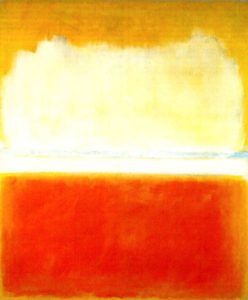
Mark Rothko no-8-1952

From childhood, it seems, we are inculcated with the grand themes of Passover: freedom from slavery! Liberation! Then, in different ways, we translate those themes into usable models for our lives: just as we were liberated, so too must we work for the liberation of others. As Michael Walzer documented in his book Exodus and Revolution, the Exodus story has inspired many groups in many parts of the world to revolution, to radically change their material existence.

Sometimes however, the overwhelmingly large themes overshadow the equally important though smaller moments. Those moments are often the things that actually move the dial, make a difference in the world. There is a wonderful and very short story in the Talmud (Pesachim 115b). The story follows a detailed discussion of the intricate choreography of the seder meal, the liturgical meal that Jews celebrate on Passover eve. Food on trays is brought in and then taken out. Wine is poured and drunk, and then poured again. Foods are dipped. And so on. Continue reading